Around 25,000 people are diagnosed with Crohn’s and Colitis each year in the UK. This is likely to rise in the coming years. Around 1 in 100 people overall will live with Crohn’s or Colitis.A group of treatments called ‘advanced therapies’ are often used to help manage Crohn’s and Colitis. There are a number of different ones, all of which can work very well.
However,
1. They do not work for everyone
2. They may become less effective over time
3. Later treatments may work less well after poor response to initial treatments
This can make life difficult as it may take time to find the right treatment for you and it may mean changing treatment multiple times. During this period, patients may experience uncontrolled symptoms and unnecessary side effects which can negatively impact their quality of life. Many studies in Crohn’s and Colitis focus on people who have had the condition for some time, usually many years, and have already received some treatment. The features responsible for the disease beginning and which treatments are best suited to each person may be harder to identify so long after diagnosis. Therefore, we crucially need to understand what factors are involved when people are first diagnosed and how this influences their disease behaviour and response to treatment over time.
In order to do this, we need to collect information about your health and your lifestyle by doing questionnaires, checking your medical notes, collecting samples and analysing biological markers in your blood, stool and biopsy tissue.We aim to collect this information and samples from 1,000 people with Crohn’s and Colitis.
We will also use the information collected at the beginning from those patients who enter the study but don’t go on to be diagnosed with Crohn’s or Colitis (approximately 1,000), and will collect further information from medical records after 3, 12, 24, 36 and 48 months. Comparisons between people with and without Crohn’s or Colitis may help us in future to predict who could go on to develop Crohn’s or Colitis or other related conditions.
If you agree to take part, you will be asked to sign a consent form either before or during your first clinic visit. This can be done remotely on an electronic device or can be completed on a paper form. We will therefore ask you to provide your email address.
Alongside the standard procedures that will be undertaken to assess your symptoms and whether you have Crohn’s or Colitis or not, we will collect some information for research purposes. This will include information about your health and medical history and some questionnaires looking at your symptoms, physical activity and diet. We will collect a blood sample and provide you with a kit to collect a stool sample at home and post it directly to our lab. Additionally, when you undergo a colonoscopy procedure, some tissue samples (biopsies) will be collected, and we would like to take some additional samples for research purposes.
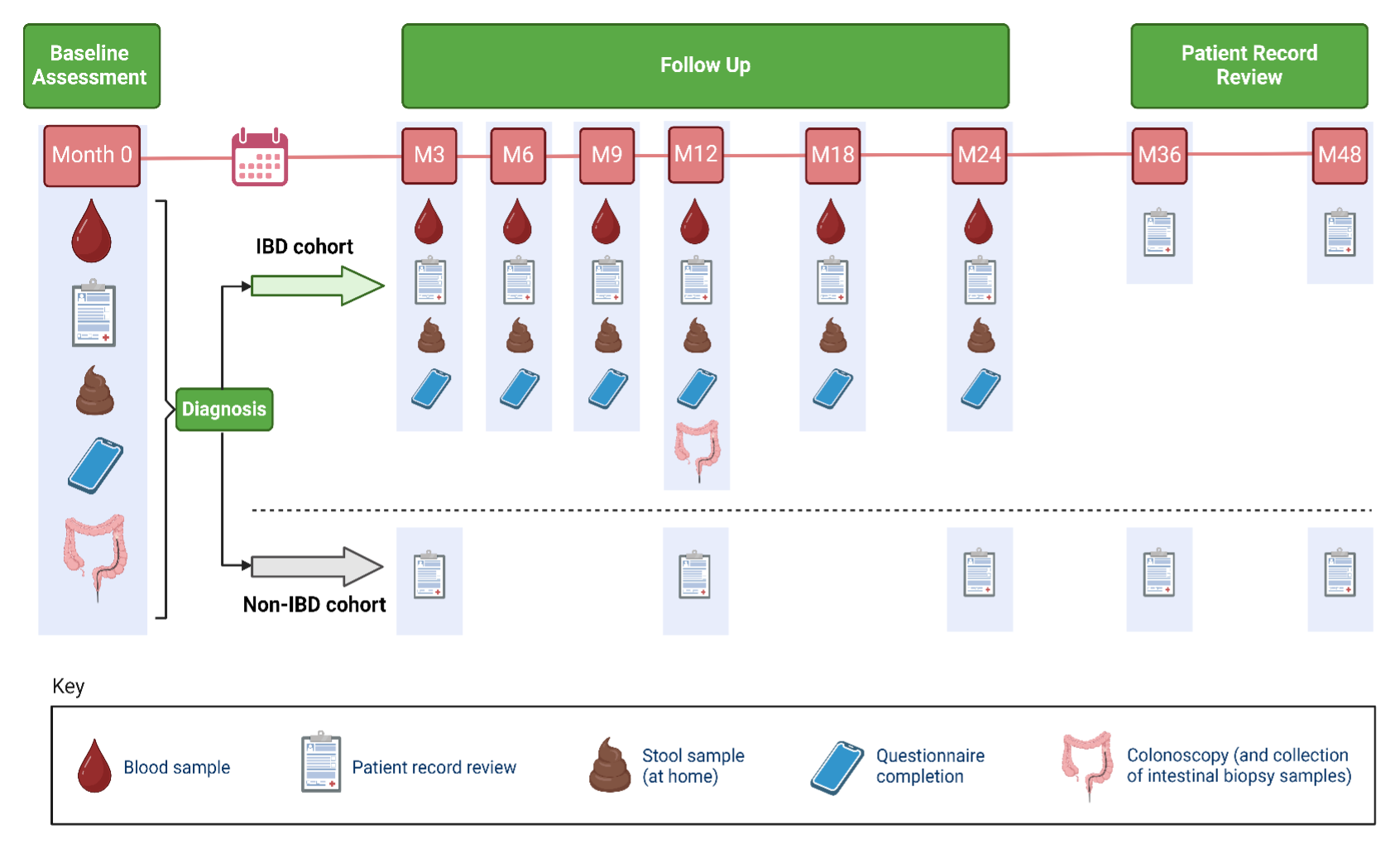
If after this initial visit you are diagnosed with Crohn’s or Colitis, you will be invited to attend 6 clinic visits over the next 2 years where you will be asked to complete similar questionnaires and provide further blood and stool samples as shown in diagram below.
You will be asked to have a follow up colonoscopy after 12 months, with biopsy samples taken. All visits will be carried out under the care of the clinical team at your hospital who are involved in this research study. You will therefore receive regular check-ups from a dedicated team of specialists throughout your involvement in the study. If you are not diagnosed with Crohn’s or Colitis after the initial visit, you will not need to provide any further information or samples directly.
However, we would like to collect valuable information about any Crohn’s and Colitis symptoms or subsequent related conditions from your medical records after 3, 12, 24, 36 and 48 months. Please note, whilst not being diagnosed with Crohn’s or Colitis would mean you are no longer actively take part in the study, you would be fully supported in the usual way from your healthcare team with whatever follow on care or investigation is needed.
More detail about what information and samples will be collected at each visit is provided below. This applies to all patients at the baseline (pre-diagnosis) visit. If you are then confirmed to have Crohn’s or Colitis, you will be asked to attend at 3, 6, 9, 12, 18 and 24 months after the first visit. At each of these time points the following activities will take place:
We will collect some information from your medical notes including relevant medical history, current and previous medications and lifestyle details such as smoking habits, employment, education or training details. We will also collect the first part of your current postcode. These details will be collected by the team at your local hospital using your medical notes, however you may be asked to confirm answers to questions the research team are unsure about.
Information from your medical notes regarding related conditions, symptoms and treatments will also be collected at 3 and 4 years after the initial visit for those diagnosed with Crohn’s and Colitis. People not diagnosed with Crohn’s or Colitis will have this information collected from their medical notes at 3, 12, 24, 36 and 48 months. This will involve the research team at your hospital remotely accessing your medical record and you will not be required to visit the hospital or answer any questions.

We will ask you to complete a series of questionnaires. There are 10 in total, and they include questionnaires about symptoms, fatigue, stool consistency, as well as the impact that your condition is having on your quality of life. Additionally, we will also ask questions about your physical activity levels and how often you eat certain foods.
Most of these questionnaires can be completed very quickly. The questionnaire about your diet can take approximately 30 minutes to complete, however this one will be collected every 6 months in year 1 and annually in year 2 rather than at every visit. If English is not your primary language, some questionnaires may be available in additional languages.
If you do not complete all of the questionnaires during your study visit, they can be completed from home either on your own mobile device, on paper, or by giving answers over the phone to a member of the research team. You will receive reminders by email as a prompt if you have uncompleted questionnaires after your visit.

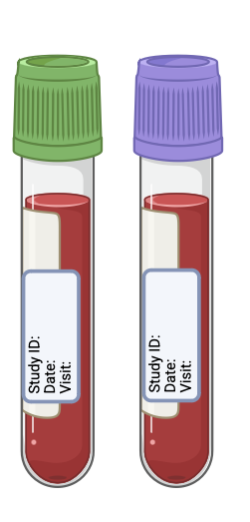
You will be asked to provide a blood sample at each visit. We will collect approximately 20 ml of blood (approximately 4 teaspoons), which will be sent by the study team at your hospital to the Open-IBD team at the Wellcome Sanger Institute labs in Cambridge. Your samples will be labelled with a unique study ID number, meaning that no personally identifiable information is associated with your sample. Researchers at the Wellcome Sanger Institute will look at the genetic information in the cells within your blood sample.
The remaining blood (including plasma, the liquid part of blood that carries the cells) will be stored for further analysis and then sent to Newcastle University for biobanking (storing for future research use).
You will be asked to provide stool samples at each time point using a home collection kit provided by the study team at your hospital. The kit may be given to you when you are at the hospital or it may be sent to you by post.
The kit will contain all you need to collect a stool sample at home, including instructions. You will be asked to collect stool from one bowel movement and transfer a small amount into 3 different tubes using the equipment provided. The kit will contain pre-addressed, freepost return packaging that you can use to post your stool sample to the Newcastle University research laboratory using a regular post box. The samples will be analysed to look at inflammation levels and gut microbes then biobanked (stored for future research use).

One of the tests you will undergo when under investigation for suspected Crohn’s or Colitis is a procedure using a camera to examine the bowel called a colonoscopy. Samples of tissue are already routinely taken during these procedures as part of standard NHS care, but if you agree to take part in this study, we will ask for additional biopsy samples to be collected. We will ask to collect up to 16 additional samples in total from the parts of your bowel affected by suspected Crohn’s or Colitis. While the colonoscopy test can be uncomfortable, the process of taking biopsies is painless to the patient.
If it is confirmed that you have Crohn’s or Colitis and you are still taking part in the study, you will be asked to have this same procedure 12 months after your first visit, where further biopsy samples will be collected. Although having a colonoscopy at 12 months after diagnosis is not currently standard practice, it is considered to be a feature of high-quality care and will give more accurate information about the activity of your disease.
Biopsy samples will be sent to the Wellcome Sanger Institute and Newcastle University for analysis. Any remaining biopsy tissue will be anonymously stored at Newcastle University for use in potential future research (biobanked). If you are booked in for a colonoscopy at the same time as your study visit, we will ask you to collect your stool samples and complete the questionnaires before your colonoscopy. This is because the bowel preparation/cleansing that you need to take for the procedure may have an impact on your gut microbes. In some cases your clinical team may choose to do a shorter camera test than a colonoscopy, called a flexible sigmoidoscopy which only goes part way round your bowel. Research biopsies can be collected during this test instead.

We would like to keep you updated with study progress and key milestones, as well as results and outcomes. We may also want to ask you for feedback on your experiences of taking part in Open-IBD. This is optional and will not affect your participation if you do not wish to take part in this aspect of the study.